Insights
KR Decarbonization Magazine
VOL.12 | MARCH 2026
- Navigating Another “Moment of Uncertainty”
- Shifting Political Signals, Unchanging Physical Reality
- Regulatory Complexity: No Single Answer
- The Need for Data-Driven Strategy: From Intuition to Calculation
- Decarbonization Options: The Art of Choice and Combination
- Confronting “Regulatory Costs” for the First Time
- Decarbonization Is a Pathway, Not an Event
- Strategy Matters in Pathway Selection
- The Goal, a Strategy Tailored to Each Operator
PILOT & POWER
Designing Decarbonization Strategies with PILOT
Kim Yeongho Principal Surveyor Technical Business Development Team

|

Navigating Another “Moment of Uncertainty”
The IMO Marine Environment Protection Committee Extraordinary Session (MEPC ES.2), held in London in October 2025, concluded with a degree of uncertainty that few within the shipping industry had anticipated. The formal adoption of the IMO Net-Zero Framework (NZF)—the session’s central agenda item—was ultimately postponed by one year. Rather than moving directly into implementation, the launch of a comprehensive global decarbonization regulatory framework was delayed by at least twelve months.
The NZF is intended to serve as a core mid-term measure under the IMO’s greenhouse gas reduction strategy, encompassing global fuel standards alongside a carbon pricing mechanism. During MEPC ES.2, however, member states were unable to reach sufficient consensus, and the meeting closed with further discussions deferred to a future session.
Debate throughout the session was intense. Some member states and industry stakeholders called for greater regulatory predictability and a clearly defined implementation timeline, while others highlighted concerns related to economic impact, procedural readiness, and the equitable distribution of regulatory burdens. As a result, the roadmap that had once been framed around a 2027 entry into force now requires fundamental reassessment.
This outcome represents more than a simple scheduling delay. For shipowners and investors alike, it signals an expansion of regulatory risk and a deepening of structural uncertainty. While the overall direction toward decarbonization is broadly shared, the pace, form, and cost of future regulation remain unclear. In the post–MEPC ES.2 landscape, the central question is no longer whether regulation will tighten, but rather how, when, and at what cost it will materialize.
Reactions to the meeting have been mixed. Some view the postponement as an opportunity to build more durable consensus, while others criticize it as a setback in responding to the climate crisis. Regardless of perspective, one reality is unmistakable: The reality that the shipping industry must strategically navigate the uncertainty and volatility of decarbonization regulations has become clearer than ever.
Shifting Political Signals, Unchanging Physical Reality
This uncertainty is not confined to IMO deliberations. At the same time, political messaging surrounding decarbonization has grown increasingly volatile. A symbolic example emerged at the 2025 APEC meeting in Gyeongju, Republic of Korea, where the U.S. President referred to what he described as “Beautiful Clean Coal.”
Skepticism toward climate policy and decarbonization initiatives continues to surface within parts of the political landscape. In some countries, energy security and industrial competitiveness have prompted renewed attention to the role of fossil fuels. The global momentum toward decarbonization may appear to be wavering.
Yet political discourse does not alter physical reality. Global average temperatures continue to rise, and a growing body of scientific analysis indicates that the Paris Agreement’s 1.5°C target has effectively moved beyond reach. At this stage, the critical issue is no longer whether the target can still be met, but the fact that climate change is already unfolding.
Climate change is not a matter of ideology or policy preference—it is a physical phenomenon. Its consequences are becoming increasingly tangible across industries, and shipping is no exception. Fuel choices, vessel design, operational practices, and even crew composition are all being reshaped around a single organizing principle: decarbonization.

Regulatory Complexity: No Single Answer
The challenge lies in the absence of a single, unified regulatory framework. In the past, environmental compliance often meant responding to one standard, one indicator, and one technical requirement. Today’s decarbonization landscape is fundamentally more complex.
IMO regulations, EU measures, and various regional policies now overlap, each operating on distinct timelines and employing different metrics. For some vessels, compliance with the IMO’s Carbon Intensity Indicator (CII) is the most immediate concern; for others, exposure to EU ETS costs is more pressing. Older vessels face constraints that differ markedly from those of newbuildings, and optimal strategies vary significantly by ship type and trading pattern.
Accordingly, the industry’s central question has shifted. It is no longer, “Which technology is the most environmentally friendly?” but rather,
“What is the most realistic decarbonization pathway for our fleet?”
There is no single correct answer. Decarbonization strategies are increasingly vessel-specific and fleet-specific, requiring phased approaches grounded in careful judgment and scenario-based comparison.

The Need for Data-Driven Strategy: From Intuition to Calculation
In this environment, the difficulty of decarbonization strategy is self-evident. Costs and effects accumulate over long time horizons, and investment decisions made today will shape competitiveness ten or twenty years into the future. Abstract notions of sustainability offer little practical guidance under such conditions.
The real challenge lies in determining what should be calculated—and how those results should be interpreted. Regulatory frameworks are complex, variables are numerous, and no single assumption can support a sound decision. Decarbonization strategy must therefore be understood not as the search for one definitive answer, but as a structured comparison among multiple plausible options.
Against this backdrop, the Korean Register has introduced the PILOT platform, incorporating scenario planning, compliance cost analysis, and pathway-based strategy design. Rather than positioning specific regulations or technologies as solutions, PILOT enables users to examine multiple assumptions and conditions simultaneously, reframing decarbonization as a matter of ongoing management rather than one-time decision-making.
The platform’s structure reflects this philosophy. Users define distinct scenarios, assess regulatory exposure and cost impacts, combine emission-reduction options, and compare total costs and payback periods. Through this process, decarbonization is approached not as a single commitment, but as a strategic exercise requiring continuous review and adjustment. In this sense, PILOT is not a tool that selects fuels or technologies on behalf of the user; it is a decision-making framework that integrates regulation, cost, and time.
PILOT Dashboard Overview


Decarbonization Options: The Art of Choice and Combination
Decarbonization often feels abstract not because solutions are lacking, but because there are too many. LNG, methanol, ammonia, biofuels, and e-fuels have all reached demonstration or early commercial stages. When combined with energy-saving devices, speed reduction strategies, operational optimization, and onboard carbon capture systems, the number of potential configurations for a single vessel becomes daunting.
This is where the true challenge emerges. The question is no longer, “Which technology is the greenest?” but rather, “Which option should be applied to which vessel, under which operating conditions, and at what point in time?”
Answering this requires an integrated view of time, cost, and regulation. A vessel with five years of remaining service life faces fundamentally different decisions from one expected to operate for two decades. Even if a fuel option offers regulatory advantages after 2040, its value diminishes if the vessel will not remain in service long enough to realize those benefits.
Here, PILOT brings decarbonization discussions back into the realm of practical decision-making. It does not promote any technology as a universal solution. Instead, it allows users to define vessel-specific and fleet-level scenarios, combining technological options and evaluating them across regulatory costs, fuel costs, CAPEX, and OPEX.
Ultimately, decarbonization strategy is not a technological problem—it is a decision-making problem. PILOT provides the language of calculation that makes those decisions possible.
Confronting “Regulatory Costs” for the First Time
For many shipowners, decarbonization becomes tangible at a specific moment: when regulatory costs appear as concrete numbers. Not in charts or policy papers, but as line items.
As EU ETS costs accumulate year by year and IMO-related compliance costs take financial form, decarbonization shifts from a distant concern to an immediate operational issue. At that point, the central question changes—from “Is this environmentally right?” to “How do we manage this cost?”
This is where PILOT’s Compliance Assessment function plays a critical role. By visualizing vessel-specific GHG emissions, CII rating changes, and resulting annual regulatory costs, the platform translates abstract policy discussions into financial terms.
Importantly, these costs are not fixed. Fuel prices, carbon prices, exchange rates, and regulatory stringency interact dynamically. PILOT allows users to adjust these variables and observe how outcomes change under different assumptions. It is not merely a calculation tool, but a structured space for reasoning about uncertainty. While the future cannot be predicted with certainty, comparing multiple plausible futures side by side makes strategic choice far more grounded.
Compliance Cost in Scenario


Decarbonization Is a Pathway, Not an Event
Treating decarbonization as a single event almost guarantees strategic failure. Expectations that one fuel switch or retrofit will solve the challenge underestimate its complexity. In reality, decarbonization unfolds along a pathway composed of multiple stages.
In the short term, operational improvements and speed reduction may deliver the greatest gains. In the medium term, energy-saving devices or partial fuel blending may become viable. Over the long term, full fuel conversion or large-scale capital investment may be required.
Such staged approaches matter because they distribute cost and risk over time. PILOT’s pathway concept embeds this logic into the system, enabling users to sequence reduction options and compare cumulative costs and payback periods. The objective is not to identify the “greenest” pathway, but the most manageable one.
Notably, optimal pathways are rarely static. Changes in fuel price assumptions or carbon prices can alter priorities rapidly. PILOT reflects this reality by allowing strategies to evolve dynamically, reinforcing the need for continuous strategic updating rather than one-off planning.
Setting up Decarbonization Pathway

Strategy Matters in Pathway Selection
PILOT evaluates multiple decarbonization pathways over a vessel’s remaining service life and calculates the pathway that appears most advantageous from an economic perspective. This capability is highly valuable as a starting point, as it allows complex alternatives to be compared at a glance and provides a clear foundation for developing a decarbonization strategy.
One important point, however, merits careful consideration. The “optimal pathway” identified by PILOT is derived based on a single, transparent criterion: cost. While this offers a meaningful basis for quantitatively comparing complex options, it represents only the starting line of decision-making rather than its conclusion.
In practical decision-making, additional factors that are difficult to reflect directly in calculations—such as the time and effort required for implementation, operational constraints, and opportunity costs associated with each option—must also be taken into account. Accordingly, PILOT’s results are best understood not as answers that replace decision-making, but as reference benchmarks that support strategic judgment.
For example, consider a vessel with an expected end of service life in 2045. If the cumulative cost difference between the first- and second-ranked decarbonization pathways suggested by PILOT amounts to only a few million dollars, it may be insufficient to base the final decision solely on numerical ranking. In such cases, it becomes necessary to assess how well each pathway aligns with actual operating conditions and the owner’s broader strategic objectives. At this point, strategy extends beyond numerical comparison into the realm of judgment informed by experience and forward-looking perspective.
Viewed in this context, PILOT functions less as a tool that delivers definitive answers and more as a decision-making framework that helps users refine scenarios, test assumptions, and identify the option that best fits their specific circumstances.
A practical illustration can be found in the case of PCTCs. Given that a significant share of recent PCTC newbuildings has been ordered with LNG dual-fuel specifications, reflecting this reality within PILOT requires a strategic approach. By selecting only LNG dual-fuel PCTCs during the scenario setup stage and assigning a CAPEX value of zero to the LNG conversion option in the GHG reduction settings, users can compare pathways based on already-secured specifications rather than hypothetical retrofits. Such fine-tuning brings calculated outcomes one step closer to real-world decision-making.
Ultimately, what matters most is how user experience and judgment are layered onto the results produced by PILOT. Numbers can indicate direction, but strategy is formed through interpretation. This is precisely what is meant by saying that pathway selection itself requires strategy.
Cost of each Pathways


The Goal, a Strategy Tailored to Each Operator
As MEPC ES.2 has demonstrated, the direction of decarbonization may at times appear unstable. Regulatory pace and mechanisms remain fluid, and gaps persist between political messaging and technical reality. Yet one point remains clear: the direction toward reducing carbon emissions will not reverse.
The real question is how that direction is followed. Some operators will move quickly; others will proceed step by step. These choices are not about right or wrong, but about alignment with each operator’s circumstances and constraints.
Transforming such choices from intuition into calculation, from declaration into strategy, requires a structured framework for thinking. As this article has shown, decarbonization is not a matter of a single technology or short-term commitment, but a long-term decision-making process that integrates regulation, cost, and time.
This is where PILOT finds its role. It does not provide all the answers, but it helps users ask the right questions, compare alternatives, and adjust strategies as conditions evolve. The journey toward decarbonization is long and complex—but it need not be undertaken alone.
For those seeking to design a decarbonization strategy tailored to their own reality, and to manage that journey systematically, the time has come to begin that conversation with PILOT.
Decarbonization Strategy Plan

- Prologue: Why Now? The Starting Point for Critical Decisions
- Data Independence: Turning Burdens into Innovation
- AIS-Based Operational History: Reading the ‘Operational DNA’
- Integrating ERA5: Turning Environmental Variables into Controlled Logic
- IMO DCS: Achieving Analytical Integrity with Verified Figures
- Epilogue: The Most Pragmatic First Step Toward Decarbonization
PILOT & POWER
POWER: The Genesis of Data-Driven
Decarbonization Decision-Making
KIM Minsu Principal Researcher, Ship & Offshore Technology Team

|

Prologue: Why Now? The Starting Point for Critical Decisions
In the shipping industry, decarbonization is no longer a choice, it is a matter of survival. Shipowners are navigating a sea of stringent environmental regulations, from the Carbon Intensity Indicator (CII) to the IMO’s Net-Zero Framework (NZF).
However, every successful strategy begins with an accurate diagnosis, and here lies the greatest hurdle: Data. Sensor capabilities vary by vessel, and data quality remains inconsistent across fleets. Building a high-fidelity, real-time data infrastructure for an entire fleet requires immense capital and time. POWER was born from this cold reality. Instead of waiting for "perfect" data, it utilizes proven, verified data to provide the most pragmatic "First Compass" for the era of decarbonization.
Data Independence: Turning Burdens into Innovation
Traditional analytics platforms demand granular operational data from shipowners. This often creates a heavy administrative burden and raises significant concerns regarding data security and sensitivity. POWER flips this paradigm. It operates independently of proprietary shipowner data, utilizing only official data verified by Korean Register (KR). By reconstructing past operations and conducting macroscopic comparative analyses based on trusted data, it enables immediate fleet-wide assessments without the typical overhead.
Main Dashboard

AIS-Based Operational History: Reading the ‘Operational DNA’
The core of decarbonization analysis is understanding how a vessel is operated. POWER leverages AIS (Automatic Identification System) data to go beyond simple location tracking:
· Trajectory Reconstruction: Rebuilding time-series voyage profiles.
· Operational Profiling: Extracting trends by key sea areas, speed distributions, and laden/ballast conditions.
· Pattern Recognition: Filtering out short-term outliers to identify the vessel’s fundamental "Operational DNA."
Operational Characteristics


Integrating ERA5: Turning Environmental Variables into Controlled Logic
Traditional analytics platforms demand granular operational data from shipowners. This often creates a heavy administrative burden and raises significant concerns regarding data security and sensitivity. POWER flips this paradigm. It operates independently of proprietary shipowner data, utilizing only official data verified by Korean Register (KR). By reconstructing past operations and conducting macroscopic comparative analyses based on trusted data, it enables immediate fleet-wide assessments without the typical overhead.
AIS + Weather

IMO DCS: Achieving Analytical Integrity with Verified Figures
The final piece of the performance analysis puzzle is reliability. POWER adopts the IMO DCS (Data Collection System) verified by KR as its analytical baseline. These annual figures serve as the most authoritative, objective evidence of a vessel’s actual fuel consumption and emissions.
By fusing AIS-based patterns and ERA5 environmental data with these verified DCS figures, POWER completes a multidimensional interpretation of "why" certain emission results occurred. We transform static annual figures into dynamic insights, providing ship managers with the context needed for immediate action.
Fuel Consumption

Epilogue: The Most Pragmatic First Step Toward Decarbonization
The core value of POWER lies in the clarity of data-driven performance analysis. Before committing to expensive sensor installations, shipowners can now evaluate their fleet’s status using the official data they already possess. This is the bedrock of decarbonization. By converting raw data into actionable knowledge, POWER offers the most realistic and powerful framework for strategic decision-making in the maritime transition.

Biofuel Series – Part Ⅱ
Safe Use of Marine Biofuel Blends:
Fuel Quality Issues and Operational Lessons from Field Experience
HA Seungman Principal Surveyor of KR Machinery Rule Development Team&
VISWA GROUP, R&D Manager Ms. Sara Rezaee


This edition of the Biofuel Series explores fuel quality characteristics and operational considerations for marine biofuel blends, based on practical experience and test data from VISWA*, a global marine fuel testing and inspection organization.
* Founded in 1991 and headquartered in Houston, Texas, USA, The Viswa Group is a global marine fuel testing and inspection organization. Over the years, it has expanded into a multidisciplinary laboratory network supporting a broad range of industries, with expertise in residual fuels (bunkers), distillate fuels (gas oils), additives, lubricants, greases, ballast water and environmental testing. The company operates laboratories in key locations worldwide, including the United States, the United Kingdom, the United Arab Emirates, Singapore, India and China, providing testing, consultancy and technical support services to the maritime industry.
Current Market Snapshot: Biofuel Blends in Marine Fuels
· Overview of biofuel and biodiesel-blended fuels observed in VISWA testing (e.g. prevalence of B24)
· Residual-based versus distillate-based biofuel blends
· Practical implications of blend fuels in the early adoption phase
The number of biofuels and biodiesel blends with residual or distillate fuels is increasing in the marine industry. According to the 2024 IMO Data Collection System (DCS) data*, the reported consumption of biofuels reached approximately 1.22 million tonnes. This represents nearly a threefold increase compared to 0.39 million tonnes in 2023, indicating a rapid expansion in the use of biofuels within the marine fuel mix.
*MEPC 84/6/1 Report of fuel oil consumption data submitted to the IMO Ship Fuel Oil Consumption Database in GISIS (Reporting year: 2024)
Aggregated annual fuel consumption of ships of 5,000 GT and above in 2024

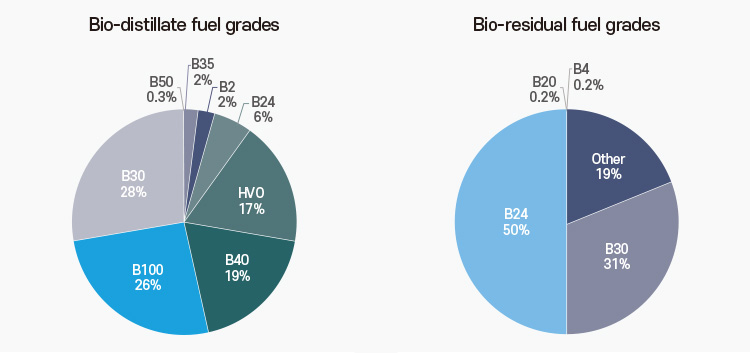
Based on VISWA’s 2025 data, approximately 1% of the fuels tested by VISWA were biofuels. Among these biofuels, 57% were bio-residual fuels and 43% were bio-distillate fuels.
The Chart below shows the distribution of grades for bio-distillate and bio-residual fuels. B30 was the predominant grade within bio-distillate fuels, whereas B24 was most commonly observed among bio-residual fuels.
The Chart below shows the contrast between the characteristics of bio-distillate and bio-residual fuels. Overall, the quality of bio-residual fuels is comparable to that of VLSFOs, with lower average viscosity, density, and micro carbon residue (MCR). The quality of bio-distillate fuels is very similar to that of MGOs.
Bio-distillate vs bio-residual fuels characteristics
| Parameter | Unit | Bio-distillate | Bio-residual | ||||
|---|---|---|---|---|---|---|---|
| Min | Max | Avg | Max | Min | Avg | ||
| Density at 15 deg C | kg/m³ | 786.1 | 885.5 | 862.3 | 866.0 | 990.0 | 939.7 |
| Viscosity at 40 deg C | cSt | 2.3 | 6.9 | 3.9 | - | - | - |
| Viscosity at 50 deg C | cSt | - | - | - | 10.4 | 297.7 | 50.9 |
| Upper Pour Point | C | -6 | 12 | -2 | -18 | 33 | 13 |
| Water | vol% | 0 | 0.18 | 0.01 | 0.03 | 0.90 | 0.19 |
| Micro Carbon Residue | mass% | 0 | 3.66 | 0.02 | 0.21 | 18.12 | 6.21 |
| Sulfur | mass% | 0.001 | 0.190 | 0.048 | 0.03 | 3.49 | 0.68 |
| Total sediment Potential | mass% | 0 | 0.05 | 0 | 0.01 | 0.26 | 0.02 |
| Ash content | mass% | 0 | 0.005 | 0.003 | 0.001 | 0.071 | 0.015 |
| Aluminum (Al) | mg/kg | <1 | 2 | <1 | <1 | 78 | 8 |
| Vanadium (V) | mg/kg | <1 | 5 | <1 | <1 | 135 | 19 |
| Sodium (Na) | mg/kg | <1 | 17 | <1 | <1 | 77 | 13 |
| Silicon (Si) | mg/kg | <1 | 4 | <1 | <1 | 70 | 8 |
| Aluminum + Silicon (Al+Si) | mg/kg | <1 | 4 | <1 | <1 | 148 | 16 |
| Magnesium (Mg) | mg/kg | <1 | 3 | <1 | <1 | 8 | 1 |
| Calcium (Ca) | mg/kg | <1 | 7 | <1 | <1 | 95 | 11 |
| Phosphorus (P) | mg/kg | <1 | 4 | <1 | <1 | 15 | 1 |
| Iron (FE) | mg/kg | <1 | 7 | <1 | <1 | 81 | 11 |
| Lead (PB) | mg/kg | <1 | 3 | <1 | <1 | 6 | <1 |
| Nickel (Ni) | mg/kg | <1 | 3 | <1 | <1 | 43 | 10 |
| Zinc (Zn) | mg/kg | <1 | 2 | <1 | <1 | 69 | 1 |
| Potassium (K) | mg/kg | <1 | 9 | <1 | <1 | 168 | 4 |
| CCAI | No unit | - | - | - | 772 | 873 | 828 |
| Acid number | mg KOH/g | <0.01 | 0.92 | 0.10 | 0.01 | 2.05 | 0.53 |
Bio-distillate vs bio-residual fuels characteristics

Regarding net heat of combustion, B30 blends can exhibit up to a 5.3% reduction in calorific value, while B100 shows approximately an 8.4% lower calorific value compared with the average calorific value of VLSFOs (41.6 MJ/kg). In terms of off-specification parameters, the most common off-spec parameter for both bio-distillate and bio-residual fuels was pour point.
From an operational perspective, the number of reported problem cases has been limited so far. Vessels operating on biofuels that meet the definition and standards set out in ISO 8217:2024 have generally not experienced significant issues, provided certain operational considerations are addressed.
During the early stages of biofuel usage, questions were raised regarding machinery compatibility and fuel quality. Most original equipment manufacturers (OEMs) have since issued detailed guidelines on the compatibility of their systems with biofuels. With respect to fuel quality, ISO 8217:2024 was released, which includes two additional tables: one for bio-distillate fuels and one for bio-residual fuels. In addition, CIMAC published a guideline for the use of biofuel blends titled “Fuels | ISO 8217:2024 – Marine fuels containing FAME: A guideline for shipowners & operators.”
At the beginning of biofuel usage, and due to limited operational experience, some users encountered challenges such as increased sludge formation in purifiers (example is shown in previous page) and more frequent filter clogging. These issues were generally resolved over a short period. Biodiesel blends have good solvency properties and can dissolve and mobilize sludge that has accumulated at the bottom of fuel tanks, carrying it into the purifier and filters. The observed issue was resolved after a few days and was attributed to the solvency effect of the biodiesel component.
Further explanation and clarification are needed for this photo. It is unclear whether the photo shows a purifier after overhaul and is intended to illustrate the deposits observed inside the purifier. As shown in the figure below, soft sludge accumulation in the purifier was observed after just one day of operation when a bio-residual fuel (B30) with a total sediment potential of 0.02% was introduced.
Bio-residual fuel (B30) with a total sediment potential of 0.02%

IMO DCS: Achieving Analytical Integrity with Verified Figures
· General observation that reported problem cases remain limited
· Importance of machinery compatibility, tank cleaning, and purifier setting adjustments
· Key message: biodiesel blends can be operated safely when basic precautions are taken
From an operational standpoint, reported incidents to date have remained relatively few. In general, vessels operating on biodiesel-blended fuels have not encountered major difficulties, provided that appropriate operational measures are implemented.
Addition of GCMD project and its Project LOTUS*, a six-month demonstration trial involving the continuous use of B24 biofuel on a PCTC confirmed that biodiesel had no adverse impact on engine performance, the fuel supply system, or overall vessel safety. No excessive wear or sludge accumulation beyond OEM acceptance criteria was observed, and fuel quality remained within applicable international standards.
Notably, the trial demonstrated that biofuels can be integrated into existing fuel systems without increasing operational costs, providing empirical evidence that biofuels represent one of the most practical “drop-in” solutions for near-term decarbonization. In addition, it is also noteworthy that, after six months of storage, the acid number of the B24 blend increased by approximately 2.5 times, yet remained within the limits specified in ISO 8217, and no microbial growth was observed.
Key considerations include confirming engine and equipment suitability for biodiesel blends, assessing the compatibility of onboard materials with biodiesel, performing tank cleaning prior to conversion to biodiesel products, and optimizing purifier settings in accordance with the fuel characteristics. Detailed guidance on these aspects is available in the CIMAC WG 7 publication “Fuels | ISO 8217:2024 – Marine fuels containing FAME: A guideline for shipowners & operators.”
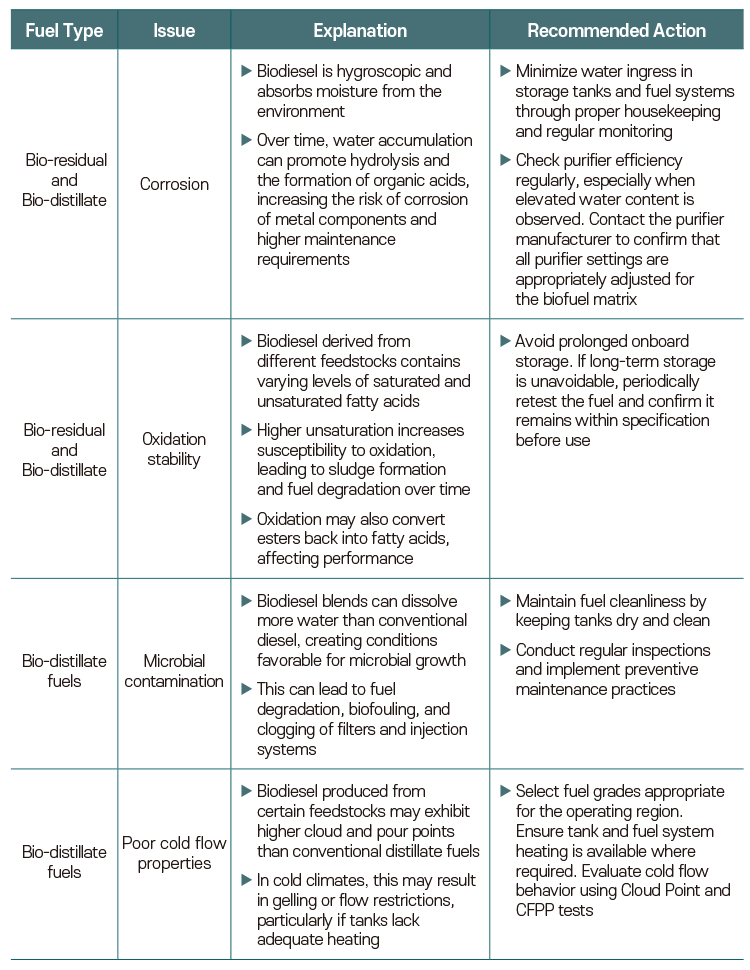
While operational experience has been largely positive, certain risks associated with the use of bio-residual and bio-distillate blends remain. These potential concerns are summarized in below, together with corresponding mitigation measures aimed at minimizing the likelihood of operational issues.
* https://gcformd.org/gcmds-project-lotus-confirms-long-term-operational-feasibility-of-b24-biofuel-blend-in-vessels/
Potential issues related to biofuels and recommended actions
| Fuel Type | Issue | Explanation | Recommended Action |
|---|---|---|---|
| Bio-residual and Bio-distillate |
Corrosion |
▶ Biodiesel is hygroscopic and absorbs moisture from the environment ▶ Over time, water accumulation can promote hydrolysis and the formation of organic acids, increasing the risk of corrosion of metal components and higher maintenance requirements |
▶ Minimize water ingress in storage tanks and fuel systems through proper housekeeping and regular monitoring ▶ Check purifier efficiency regularly, especially when elevated water content is observed. Contact the purifier manufacturer to confirm that all purifier settings are appropriately adjusted for the biofuel matrix |
| Bio-residual and Bio-distillate |
Oxidation stability |
▶ Biodiesel derived from different feedstocks contains varying levels of saturated and unsaturated fatty acids ▶ Higher unsaturation increases susceptibility to oxidation, leading to sludge formation and fuel degradation over time ▶ Oxidation may also convert esters back into fatty acids, affecting performance |
▶ Avoid prolonged onboard storage. If long-term storage is unavoidable, periodically retest the fuel and confirm it remains within specification before use |
| Bio-distillate fuels | Microbial contamination |
▶ Biodiesel blends can dissolve more water than conventional diesel, creating conditions favorable for microbial growth ▶ This can lead to fuel degradation, biofouling, and clogging of filters and injection systems |
▶ Maintain fuel cleanliness by keeping tanks dry and clean ▶ Conduct regular inspections and implement preventive maintenance practices |
| Bio-distillate fuels | Poor cold flow properties |
▶ Biodiesel produced from certain feedstocks may exhibit higher cloud and pour points than conventional distillate fuels ▶ In cold climates, this may result in gelling or flow restrictions, particularly if tanks lack adequate heating |
▶ Select fuel grades appropriate for the operating region. Ensure tank and fuel system heating is available where required. Evaluate cold flow behavior using Cloud Point and CFPP tests |
Potential issues related to biofuels and recommended actions
Key parameters to look for in biofuels
· FAME Content
This test ensures that the FAME (Fatty Acid Methyl Ester) content of the fuel is consistent with the specified grade. A lower-than-expected FAME content may indicate contamination, which could cause operational issues when the fuel is used onboard.
· Energy Content (Net Heat of Combustion):
The gross/net heat of combustion is a calculated value typically suitable for conventional fuels, but it is not accurate for biofuels or biofuel blends due to the presence of oxygen in their chemical structure. Therefore, the ISO 8217: 2024 standard specifically emphasizes measuring the net heat of combustion as per ASTM D240. This value is essential for engine calibration to ensure efficient operation, and planning for biofuel blend quantity to be bunkered.
According to our data (in below), there can be a difference of up to 5.6% between the calculated and measured net heat of combustion for B30 grade fuel. For B100 grade, this difference can be as high as 13.9%. As a result, it is crucial to measure the actual energy content rather than relying on the calculated calorific value.
Net heat of combustion for B30 and B100 (calculated vs measured)

· Oxidation stability
Oxidation stability is a key property of biodiesel. The text has been revised to use more general and accessible language, as the original version contained a high level of technical terminology. Currently, oxidation stability is a parameter that can be measured for bio-distillate fuels.
· Testing Beyond ISO 8217 - What Really Matters
As new types of biofuels enter the market, additional testing may be required to evaluate their characteristics and suitability for marine applications. Based on our experience, when the biodiesel used for blending complies with ASTM D6751 or EN 14214, as referenced in ISO 8217:2024, the parameters specified in Tables 1 and 3 of ISO 8217:2024 are generally sufficient to assess fuel quality. Among these parameters, FAME content, energy content, and oxidation stability are particularly important for biodiesel fuels.
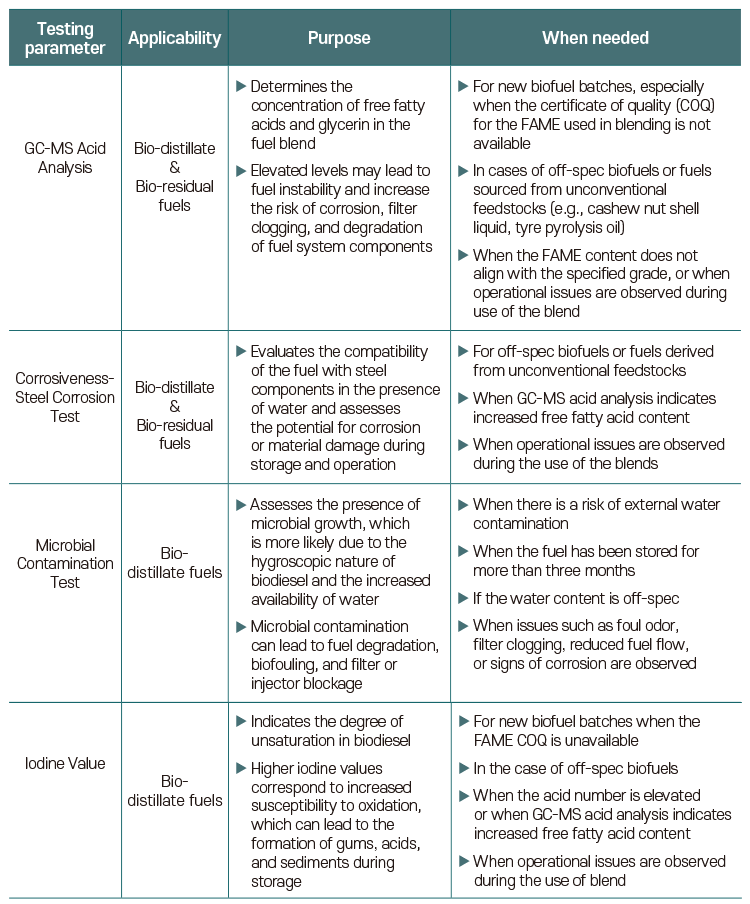
However, with the introduction of new or unconventional biofuels such as off specification biodiesel, cashew nut shell liquid blends, and pyrolysis fuels, additional testing may be necessary to properly evaluate fuel characteristics and operational risks. The recommended additional testing requirements are summarized in below.
Additional tests for evaluating the biofuels
| Testing parameter | Applicability | Purpose | When needed |
|---|---|---|---|
| GC-MS Acid Analysis | Bio-distillate & Bio-residual fuels |
▶ Determines the concentration of free fatty acids and glycerin in the fuel blend ▶ Elevated levels may lead to fuel instability and increase the risk of corrosion, filter clogging, and degradation of fuel system components |
▶ For new biofuel batches, especially when the certificate of quality (COQ) for the FAME used in blending is not available ▶ In cases of off-spec biofuels or fuels sourced from unconventional feedstocks (e.g., cashew nut shell liquid, tyre pyrolysis oil) ▶ When the FAME content does not align with the specified grade, or when operational issues are observed during use of the blend |
| Corrosiveness- Steel Corrosion Test | Bio-distillate & Bio-residual fuels | ▶ Evaluates the compatibility of the fuel with steel components in the presence of water and assesses the potential for corrosion or material damage during storage and operation |
▶ For off-spec biofuels or fuels derived from unconventional feedstocks ▶ When GC-MS acid analysis indicates increased free fatty acid content ▶ When operational issues are observed during the use of the blends |
| Microbial Contamination Test | Bio-distillate fuels |
▶ Assesses the presence of microbial growth, which is more likely due to the hygroscopic nature of biodiesel and the increased availability of water ▶ Microbial contamination can lead to fuel degradation, biofouling, and filter or injector blockage |
▶ When there is a risk of external water contamination ▶ When the fuel has been stored for more than three months ▶ If the water content is off-spec ▶ When issues such as foul odor, filter clogging, reduced fuel flow, or signs of corrosion are observed |
| Iodine Value | Bio-distillate fuels |
▶ Indicates the degree of unsaturation in biodiesel ▶ Higher iodine values correspond to increased susceptibility to oxidation, which can lead to the formation of gums, acids, and sediments during storage |
▶ For new biofuel batches when the FAME COQ is unavailable ▶ In the case of off-spec biofuels ▶ When the acid number is elevated or when GC-MS acid analysis indicates increased free fatty acid content ▶ When operational issues are observed during the use of blend |
Additional tests for evaluating the biofuels
Operational Issues with Biofuels
Since 2024, Viswa has received reports of operational issues from several vessels using biofuel blends. Five examples are shown for this article. Four of the samples (Bio-residual Case 1 and Case 2, and Bio-distillate Case 1 and Case 3) met the ISO 8217:2017 specification; however, the measured FAME content did not align with the designated biofuel content.
Operational Issues
| Biofuel | Sample grade (as BDN) |
FAME content (%) as per ASTM D7963 / EN1078 |
Problem reported | Root Cause |
|---|---|---|---|---|
| Bio-residual (Case 1) | B100 | 39 | Filter choking and fuel pump seizure | Presence of Cardanol (Cashew nut liquid) |
| Bio-residual (Case 2) | B30 | 11 | Filter choking | Presence of different types of glycerides |
| Bio-distillate (Case 1) | B24 | 10 | Leakages at the fuel pumps | - |
| Bio-distillate (Case 2) | B24 | 4 | Fuel pump issues; seizure - corrosion and wear | High content of free fatty acids, higher than 4 wt. % |
| Bio-distillate (Case 3) | Cashew nut liquid* blended with MGO (B30) | - | Breakdown of sealing components Fuel pump wear | Presence of cashew nut liquid |
*There are different types of cashew nut liquid available in the market, a few are under trails.
Only Bio-distillate Case 2 failed to meet the ISO 8217 acid number limit of 2.5 mg KOH/g, recording an acid number of 20 mg KOH/g. Please refer to previous page for further details. Reported as a B24 blend, this fuel sample showed an acid number of 20 mg KOH/g and a FAME content of only 4%. Investigative GC-MS analysis identified contamination with high levels of free fatty acids. The copper corrosion test showed a rating of 1a, the most favorable classification, indicating little to no discoloration or corrosion of the copper test strip after fuel exposure. A steel corrosion test conducted in accordance with ASTM D665 indicated that the steel rod was fully oxidized, likely due to oxidation and corrosion processes (refer to below). This outcome is expected given the significantly elevated acid number and high concentration of free fatty acids* in the sample.
* Acidic fatty acids that were either not converted into biodiesel (FAME) during the production process or formed as a result of fuel degradation, leading to an increase in acid number and subsequent oxidation and/or corrosion of fuel system components.
Steel corrosion test on Bio distillate 2 conducted as per ASTM D665

The right rod is baseline appearance and the left rod shows the steel after being in contact with the fuel Bio-residual Case 1 was graded as B100, with a measured FAME content of only 39%. GC-MS analysis showed the presence of cashew nut shell liquid (CNSL) in this sample. The fuel was not supplied as a CNSL blend and resulted in fuel pump seizure and filter choking.
Bio-residual Case 2, reported to be a B30 blend, was identified as an off-spec FAME-blended fuel. Initial testing showed a FAME content of only 11%. Further GC-MS analysis revealed a high concentration of glycerides exceeding 5%. The industry is currently investigating the applicability and operational impact of such off-spec fuels. Additional analysis of the material responsible for filter choking showed that it dissolved back into the fuel at temperatures of 90 °C.
Bio-distillate Case 3 was a cashew nut shell liquid blended with marine gas oil (MGO) at a ratio of 30%. This sample resulted in seal degradation and component damage. Due to the high concentration of phenolic compounds in CNSL, including anacardic acid in some cases, users must ensure that onboard machinery and sealing materials are compatible with CNSL-containing fuels.
The key lesson learned from these cases is that accurate determination of FAME content is a critical test for biofuel blends, as it ensures compliance with the specified fuel grade. When new types of biofuels derived from non-FAME feedstocks are used, detailed testing and controlled onboard trials should be conducted prior to widespread use.

Key Takeaways and Way Forward
Marine biofuel blends can be considered a safe and practical alternative fuel for existing ship fuel systems when appropriate fuel quality management and preventive operational measures are implemented. Recent demonstration projects and field operating experience, in particular, indicate that biofuels offer strong potential as a near-term decarbonization solution for international shipping. Nevertheless, it is also recognized that challenges related to the availability and supply of biofuels remain, particularly in terms of consistent sourcing and scalability.
At the same time, as the diversity of biofuel feedstocks continues to expand and new or non-conventional fuels enter the market, a clear understanding of fuel quality characteristics and the sharing of up-to-date operational experience are becoming increasingly important. In this context, Korean Register plans to work in close collaboration with VISWA, leveraging accumulated test results and operational insights from real-world applications to provide regular updates on biofuel quality issues and key operational considerations.
Through these efforts, Korean Register aims to continue providing practical technical references that support shipowners, shipyards, and related stakeholders in the safe and reliable use of biofuels, thereby contributing to the effective implementation of decarbonization in international shipping.
