Interview
KR Decarbonization Magazine
VOL.13 | JULY 2026
Avikus: Contributing to Decarbonization
via Digital Solutions
CEO of Avikus
Do-Hyeong Lim

|
Avikus has established itself as a global leader in the maritime autonomous navigation sector in a remarkably short period. What is the ultimate goal of “Autonomous navigation technology” as defined by Avikus, and how does it align with the maritime industry’s mega-trend of “Decarbonization”?
The ultimate goal of autonomous navigation technology, as envisioned by Avikus, is to realize “safer, more efficient, and more sustainable maritime transportation”. Ships are the most efficient mode of transport, accounting for over 90% of global trade volume, with carbon emissions per unit of cargo being only a fraction of those of aircraft. Consequently, improving the efficiency of the shipping industry directly translates into global carbon reduction.
The tightening of carbon regulations by the EU and the IMO is exerting substantial pressure on shipowners. While hardware-centered approaches - such as transitioning to eco-friendly alternative fuels or replacing engines - are necessary, they require massive initial capital investment and long transition periods.
On the other hand, software-based approaches utilizing autonomous navigation - such as optimal route design, speed control, and port arrival/departure optimization - serve as the most practical and immediate means of carbon reduction that can be applied to existing vessels right away. We are confident that as carbon regulations intensify, autonomous navigation technology will rapidly become standard for vessels, which is why Avikus is heavily focusing on this direction.
“The goal of autonomous navigation is to achieve safe and sustainable maritime transportation; improving shipping efficiency is directly linked to global carbon reduction. Software-based approaches that can be instantly applied to existing vessels without hardware replacement serve as the most practical means of decarbonization.”
“Contributing to Decarbonization” was selected as the core keyword of this interview. What do you see as the most decisive factor enabling autonomous navigation technology to reduce a vessel’s carbon emissions?
Within the industry, including the IMO, the Fuel-Saving principles of autonomous navigation are broadly categorized into four areas.
First: Operating at optimal speeds and routes that factor in ocean currents, wind, and waves.
Second: “Just-in-Time” technology, which operates vessels only at the required speeds by taking port conditions into account, capitalizing on the fact that fuel consumption increases in proportion to the cube of the ship’s speed.
Third: Optimizing operations from a total ship system perspective, considering not only propulsion energy but also auxiliary machinery, cargo management, habitability energy needs, and the operation of Wind-Assisted Propulsion Ships (WAPS).
Fourth: Saving fuel by optimizing fleet-wide operations beyond just a single vessel.
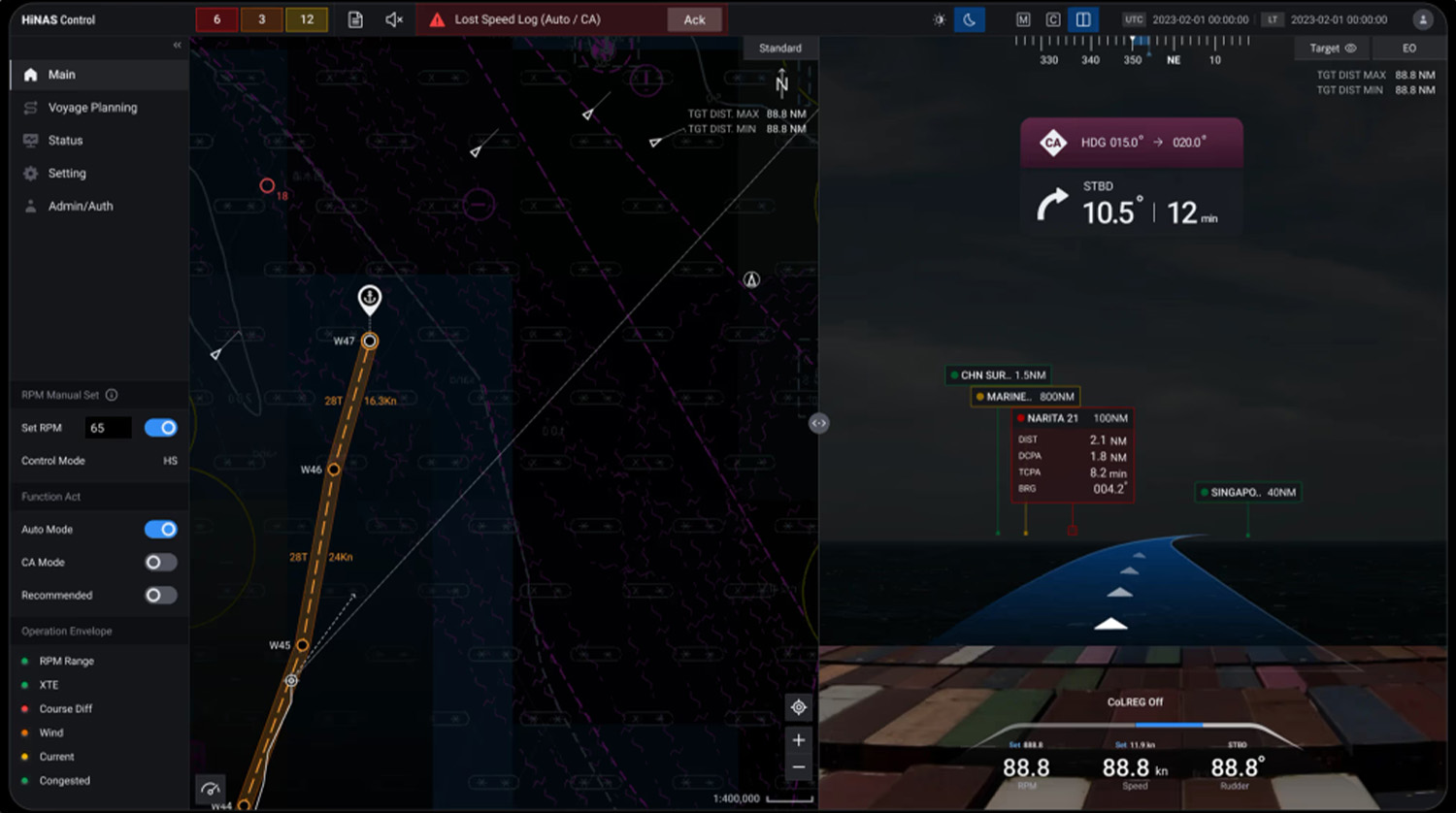
Avikus’ HiNAS has successfully realized autonomous navigation based on optimal routing and speed considering weather conditions - a technology that is immediately commercializable at the current stage - and has demonstrated a fuel saving of 4% to 6%. When the remaining technologies are sequentially integrated and applied, the carbon emission reduction is expected to grow significantly, to over 20–30%. Given that it can be deployed on existing ships immediately without hardware modifications, we believe that software-based autonomous navigation is the most immediate and realistic tool for decarbonization.
“The core elements of fuel saving are optimal route/speed operations, Just-in-Time technology, system optimization, and fleet operations, with HiNAS having demonstrated a 4–6% reduction. Integrating the remaining technologies is expected to yield carbon reductions of over 20–30%.”
HiNAS Control, Avikus’ core solution, utilizes AI to analyze weather conditions and surrounding vessel traffic to maintain an optimal route. What level of fuel savings and carbon reduction have you verified through actual voyage data?
The market still views the fuel-saving effects of autonomous navigation solutions with a degree of skepticism, largely because many claims lack validation despite having numbers. Avikus is different. Based on our analysis of over 200,000 miles of actual voyage data to date, we have confirmed an average fuel savings of 4% to 6% solely through speed optimization that accounts for currents, waves, and wind. The fact that major domestic shipping companies, including HMM, have moved beyond simple trials to adopt the system fleet-wide and manage its utilization rate as an internal KPI proves that these figures are consistently reproducible in the field.
In terms of monetary value, though it varies by vessel type and route, considering that the annual fuel cost of a large container ship is around 10 to 20 billion KRW, a mere 5% reduction allows shipowners to save 500 million to 1 billion KRW annually. Regarding Carbon Intensity Indicator (CII) ratings, vessels sitting near the boundary line can elevate their rating by a full tier with this figure alone. While our current focus is on speed optimization, the reduction effects will expand even further once route optimization capabilities are further developed and enhanced. We are confident that this represents the most immediate and economical decarbonization method, achieved entirely through software without engine retrofits or fuel conversions.
“An average fuel savings of 4–6% was verified through 200,000 miles of real voyage data, enabling cost savings of 500 million to 1 billion KRW annually for large container ships. Fleet-wide adoption by major liners like HMM proves its reliability in actual operations.”
Discussions regarding the “Evaluation of fuel-saving effects through autonomous navigation” have been highly active recently. Why is the quantitative measurement of autonomous navigation’s environmental contribution so vital, and what practical benefits (e.g., CII rating improvements) can it deliver to shipowners?
With the full-scale implementation of the CII framework, shipowners are now in a position where they must “prove” carbon reduction based on voyage data rather than just “feeling” it. A vessel’s commercial value can only be sustained if its carbon reduction can be presented to regulatory bodies and charterers in objective figures. If a standardized framework is established to evaluate how much an autonomous navigation solution contributes to CII rating improvements, it will transcend simple technology promotion and serve as a clear business justification for shipowners to adopt the solution.
In fact, for a vessel near a rating boundary, a 5% fuel saving can either upgrade its CII rating by one tier or allow it to maintain its current rating for an additional 2 to 3 years against annually tightening standards. Furthermore, if autonomous navigation solutions gain recognition as certified eco-friendly technologies, it will translate into direct economic benefits for shipping lines, including EU ETS cost reductions, securing environmental premiums during chartering, and avoiding carbon regulation penalties. Establishing such quantitative standards is essential for the proliferation of this technology, which is why Avikus is actively participating in setting these benchmarks. We have particularly high expectations for our collaboration with KR in building this evaluation framework.
“The CII era requires carbon reduction to be data-proven, making quantitative frameworks a clear business justification for shipowners. A 5% fuel saving can yield direct economic gains, such as upgrading CII tiers and lowering EU ETS costs.”
It is impressive that carbon reduction can be achieved purely through digital solutions without hardware modifications like engine retrofits or Eco-Friendly fuel conversions. What is the outlook for adopting Avikus solutions in the existing vessel retrofit market?
There are currently tens of thousands of vessels operating worldwide, and it is impossible to replace all of them with newly built ships within a short timeframe. Because HiNAS is installed by interfacing with a vessel's existing navigation equipment, it can be deployed without large-scale hardware retrofits. Notably, the fact that installation and commissioning do not require dry-docking and can be completed within 2 to 3 days while berthed at a quay is a decisive competitive edge in the retrofit market.
Placing a vessel in a dry dock incurs massive costs and operational downtime, whereas HiNAS can be installed by taking advantage of regular port calls without that burden. A solution that can improve fuel efficiency by several percentage points purely through software - without replacing engines or undergoing major construction - coupled with low entry barriers, naturally possesses powerful competitiveness in the retrofit market. To date, HiNAS Control has secured over 400 orders and completed installations on more than 100 vessels, a significant portion of which are existing ships. It is particularly meaningful that major domestic shipping companies, including HMM, are deploying HiNAS fleet-wide and managing its utilization rate as an internal KPI based on verified fuel savings.
“HiNAS can be installed within 2–3 days without Dry-Docking, giving it a critical edge in the retrofit market. It has secured 400+ orders and 100+ installations, leading to fleet-wide adoptions by major shipping companies.”
You recently successfully completed large-scale autonomous navigation trials in collaboration with major shipping lines. What aspects were shipowners and vessel operators most satisfied with during the verification process?
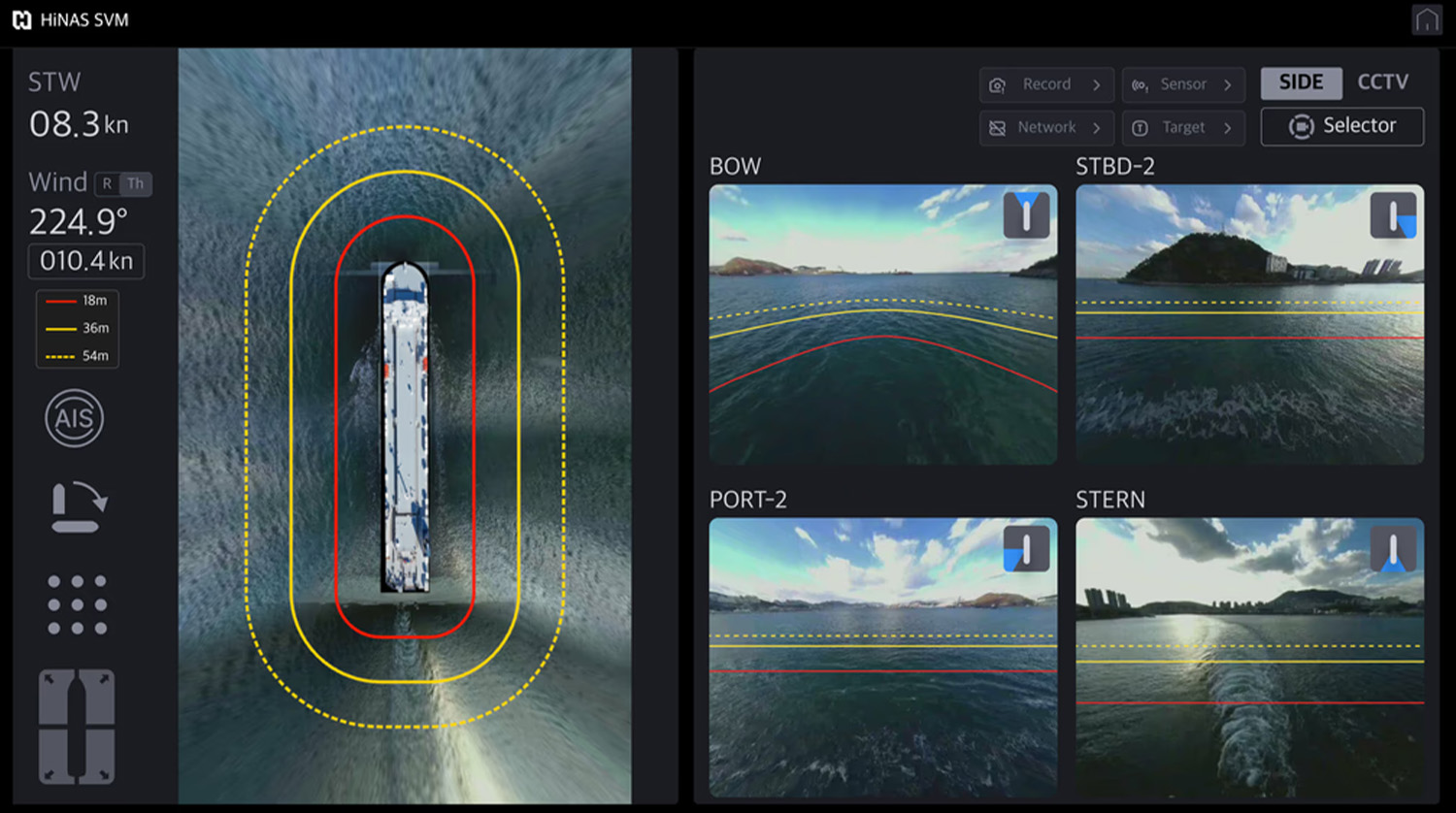
The value of autonomous navigation using HiNAS lies in cost savings through fuel reduction, carbon emission reduction, and enhanced safety through 24-hour autonomous lookout and automatic collision avoidance. Alongside this, many gave feedback that having the AI assist with continuous monitoring and decision-making in navigation duties - which usually demand 24-hour concentration - allowed crew members to focus more effectively on critical moments of judgment. It built trust that the technology does not replace the crew, but rather assists them.
HiNAS is a Level 2 autonomous navigation system that performs perception, judgment, and control autonomously, while the final responsibility for navigation remains with the navigator. Although there is still room for performance refinement, these trials have verified that it provides substantial value in terms of economics, eco-friendliness, safety, and crew welfare. Priorities differed by shipping line: large liners were most satisfied with the fuel efficiency improvements that directly cut costs, while some shipping lines placed higher value on ESG aspects such as safety enhancement and crew welfare. Either way, the common response was that the actual effects post-adoption exceeded expectations. I believe that this trust is what led to fleet-wide adoptions by major shipping lines like HMM.
“Both shipping lines and crew members evaluated the post-adoption effects as ‘Exceeding expectations,’ showing high satisfaction in both fuel savings and ESG values. AI’s 24-hour assistance fosters trust as a supportive technology, enabling crews to focus on core decisions.”
Compared to other autonomous navigation systems in the global maritime market, what unique strengths does Avikus possess in terms of “Energy efficiency” and “Eco-friendliness”?
There are already many competing solutions in the field of weather routing. However, HiNAS is currently the only solution commercially available that autonomously handles the entire process, from voyage planning to navigation, lookout, and collision avoidance. In terms of reliability and safety, HiNAS is a proven autonomous navigation solution currently undergoing type approval in cooperation with KR. We are accelerating verification with the goal of completing type approval within 2026, and once certified, it will secure unparalleled domestic and international public credibility as an “Autonomous navigation system”.
Lastly, Avikus’ true strength stems from the fact that we are not just a software company, but the autonomous navigation subsidiary of HD Hyundai Group. Developed on the foundation of 50 years of accumulated expertise and deep understanding of ship design, construction, and systems integration, our solution allows for optimization and integration from the perspective of the entire vessel system. This is a fundamentally different level of competitiveness compared to solutions created by pure software companies.
“HiNAS is currently the only commercial solution that integrates the entire process from route planning to collision avoidance, targeting KR type approval in 2026. System optimization capabilities rooted in HD Hyundai’s 50-year shipbuilding legacy represent a fundamental competitive edge over pure software companies.”
What efforts is Avikus making to ensure that autonomous ships are recognized as an “Officially accredited means of carbon reduction” within institutional frameworks like the International Maritime Organization’s (IMO) MASS Code?
Two components are required for autonomous navigation technology to be officially recognized as a carbon reduction tool: a certification framework to prove the reliability of the technology, and a quantitative standard to objectively measure fuel-saving effects. Since our inception, Avikus has worked alongside classification societies, including KR, and various flag states to establish a certification framework to verify the safety and reliability of autonomous navigation systems. Simultaneously, we have been building a system to quantitatively measure and verify fuel-saving effects, which is the core value of autonomous navigation.
Despite these efforts, there is currently no international standard to evaluate the reliability, safety, and fuel-saving effects of autonomous navigation. In this context, the non-mandatory MASS Code adopted at the recent MSC 111th session carries immense significance. However, because the MASS Code is a high-level, goal-based regulation, it does not contain specific, detailed criteria. To derive meaningful and practical standards, it is essential to base them on real-world voyage data. Avikus has submitted agenda items and information papers four times to MSC meetings for MASS Code development and is actively participating in proposing industrial standards to the ISO and IEC. We will continue to collaborate with KR and contribute to establishing practical and meaningful international standards for autonomous navigation technology.
“Avikus is actively contributing to international standardization by submitting documents to MSC meetings four times and participating in ISO/IEC standard proposals. Building on the non-mandatory MASS Code adopted at MSC 111, the company plans to spearhead practical international standards based on actual voyage data.”
The process of verifying the safety and reliability of digital solutions through collaboration with KR seems crucial. What technical collaborations or joint projects do you plan to pursue with KR in the future?
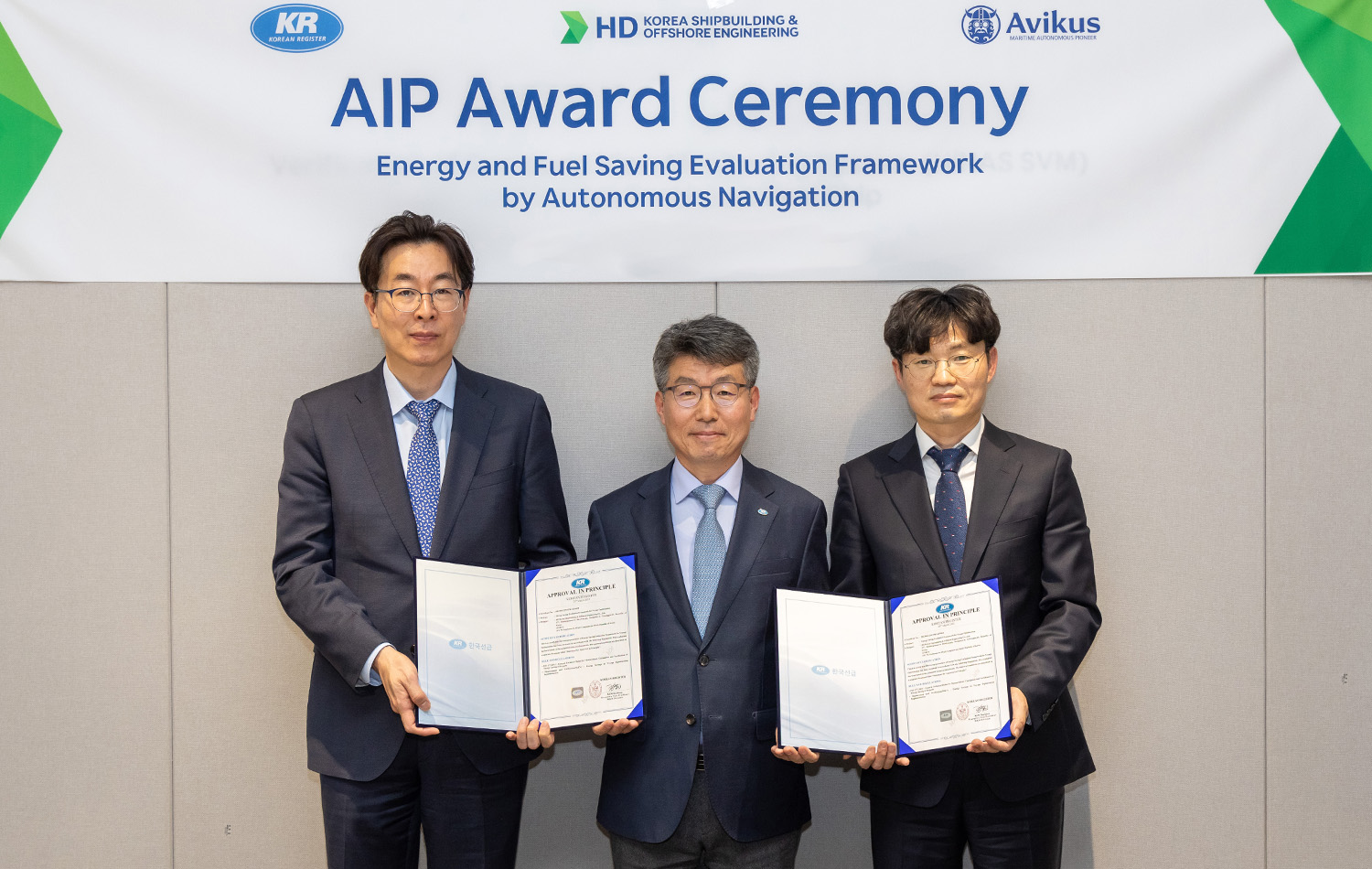
Collaboration with KR holds a significance for Avikus that goes far beyond a simple partnership. HiNAS Control is the first solution to receive the New Technology Qualification (NTQ) No. 1, KR’s new technology certification system. Being selected as the very first case of this new certification system is both a great honor and a heavy responsibility for Avikus.
Furthermore, KR played a decisive role when HD Hyundai Group became the world’s first to install autonomous navigation solutions as a standard feature on newly built vessels, helping us co-develop the HiNAS Control sea trial procedures and overcome the practical commercialization barriers of flag state approvals. KR was also the first to co-develop the framework for measuring the fuel-saving effects of autonomous navigation solutions. KR has been with us at every major milestone of HiNAS Control’s commercialization, and I would like to take this opportunity to express my gratitude.
The future is even more critical. Following the adoption of the non-mandatory MASS Code at MSC 111, the subsequent 3-to-5-year Experience-Building Phase (EBP) will be the decisive window during which practical international standards for autonomous navigation technology take shape. What kind of data we accumulate and how we do so during this period will dictate the content of future mandatory standards. If Avikus’ empirical data is combined with KR’s standardization expertise, we can make highly meaningful contributions to the standard-setting process. Fully autonomous navigation cannot be accomplished overnight; it requires certification and standards at every step as individual technologies are commercialized incrementally. Throughout this entire journey, we wish to build empirical, data-driven standards together with KR. We look forward to your continued collaboration and support.
KR is a vital partner that has shared the entire commercialization journey, including the NTQ No. 1 certification, joint procedure development, and the first fuel-saving framework development. During the upcoming 3–5 year Experience-Building Phase, Avikus plans to lead real-data-driven international standards for autonomous navigation alongside KR.”
Finally, do you have a message for the maritime and shipbuilding industry stakeholders preparing for the era of decarbonization, as well as the readers of DECARBONIZATION Magazine?
The biggest topics in shipbuilding and shipping today are decarbonization and digitalization. I believe autonomous ships represent the ultimate manifestation of digitalization, achieving both goals simultaneously. In May 2026, the non-mandatory MASS Code - the international standard for autonomous navigation - was adopted at the IMO MSC 111th session. This marked a historic moment where the framework for international regulations was established.
Autonomous ships are the ultimate technology capable of concurrently resolving three core challenges currently faced by the shipbuilding and shipping industries: crew shortages, environmental regulation compliance, and maritime safety enhancement. Just as we saw with land-based autonomous driving technology, fully autonomous technology will not emerge suddenly. It will progress through phases of increasing autonomy, and that journey has already begun. While current Level 2 technology is at a stage that assists navigators, it already delivers substantial, real-world value to both shipping lines and crews in terms of safety, convenience, economics, and eco-friendliness. As the levels of autonomy elevate, that value will grow exponentially compared to what we see today.
Decades from now, when fully autonomous ships become ubiquitous, I am certain that a vessel’s value will be determined not by its physical hull, but by the software and data embedded within it. If South Korea - armed with world-class shipbuilding technology and rich maritime expertise - can also lead the world in autonomous navigation technology at this turning point, it will transcend mere industrial achievement and redefine the very future of the Korean maritime industry. Avikus will stand at the center of that future.
“Autonomous ships simultaneously achieve decarbonization and digitalization, serving as the ultimate technology that tackles crew shortages, environmental regulations, and maritime safety all at once. Integrating autonomous navigation technology with South Korea’s existing shipbuilding and shipping prowess will redefine the future of the nation’s maritime industry, and Avikus intends to lead the charge.”