Interview
KR Decarbonization Magazine
VOL.14 | OCTOBER 2026
From LNG to Low Carbon:
Methane Slip Reduction Technologies
as a New Solution for Maritime Decarbonization
Min-ho Kang
Senior Vice President, Head of Design & Engineering,
Engine & Machinery Business Division, HD Hyundai Heavy Industries

|
Executive Summary
LNG is evaluated as a realistic bridge fuel for transitioning to next-generation zero-carbon fuels based on its mature supply chain, bunkering infrastructure, and proven engine technology. However, methane slip is a key factor that hinders the greenhouse gas reduction effect of LNG, and with the strengthening of relevant regulations, the importance of secured reduction technology and actual measurement data is growing.
Concurrent development of in-cylinder combustion improvements and aftertreatment technologies such as methane oxidation catalysts (MOC) is necessary, and HD Hyundai Heavy Industries is promoting improved methane reduction performance and durability through MOCS™. In the future, when the utilization of low-carbon fuels such as Bio-LNG and e-Methane and methane slip reduction technology advance together, the practical low-carbon and carbon-neutral competitiveness of LNG-fueled vessels is expected to be secured.
The maritime industry is currently considering a wide range of alternative fuels, including LNG, methanol, ammonia, and biofuels. How would you assess the current direction of the alternative-fuel market and the position of LNG within it?
The maritime industry is currently exploring various alternative fuels, such as LNG, methanol, ammonia, and biofuels, to seek decarbonization strategies. Among these, LNG is evaluated as the fuel with the most mature supply chain, bunkering infrastructure, and proven engine technology. Methanol and ammonia are expected to play important roles in the long term, and 2-stroke and 4-stroke methanol/ammonia marine engines are being developed and introduced to the market, but many challenges remain in terms of supply chain and economic viability. Therefore, LNG is one of the most realistic low-carbon fuels available to the shipping industry today and a practical bridge fuel toward next-generation zero-carbon fuels.
Despite the emergence of various decarbonization fuels, orders for LNG-fuelled vessels continue to be placed. Why is LNG still regarded as an important alternative fuel by the maritime industry?
Although methanol and ammonia are growing as decarbonization fuels, due to technical immaturity and lack of infrastructure, LNG is currently evaluated as the alternative that satisfies environmental performance, economic viability, and technical maturity in the most balanced way. Compared to conventional heavy fuel oil, LNG can significantly reduce CO₂, SOx, and particulate matter emissions, and suffi cient operational experience and technology have been accumulated. In addition, bunkering infrastructure is established in major ports worldwide, ensuring high fuel supply stability. For shipowners, a major advantage is relatively lower technical risk and investment uncertainty. Meanwhile, the postponement of the adoption of the IMO Net-Zero Framework to MEPC 85 last year can also be seen as background supporting the expectation that LNG's role and demand will be maintained for the time being.
LNG offers the advantage of reducing CO₂ and air-pollutant emissions compared with conventional petroleum-based fuels, but it also presents the issue of methane slip. What is methane slip, and why does it have such a significant impact on LNG’s greenhouse-gas reduction benefits?
Methane slip refers to the phenomenon where a portion of methane (CH₄) supplied as fuel in an LNG engine is discharged in an unburned state, and methane is a representative greenhouse gas with a global warming potential approximately 28 times or more greater than carbon dioxide over a 100-year period. Therefore, even if CO₂ emissions decrease, high methane slip can signifi cantly reduce the GHG reduction eff ect of LNG fuel. Recent maritime regulations are also evolving to consider CH₄ emissions alongside CO₂, making methane slip reduction a key factor determining the competitiveness of LNG-fueled vessels.
Methane Slip: GHG Challenge of LNG Fuel
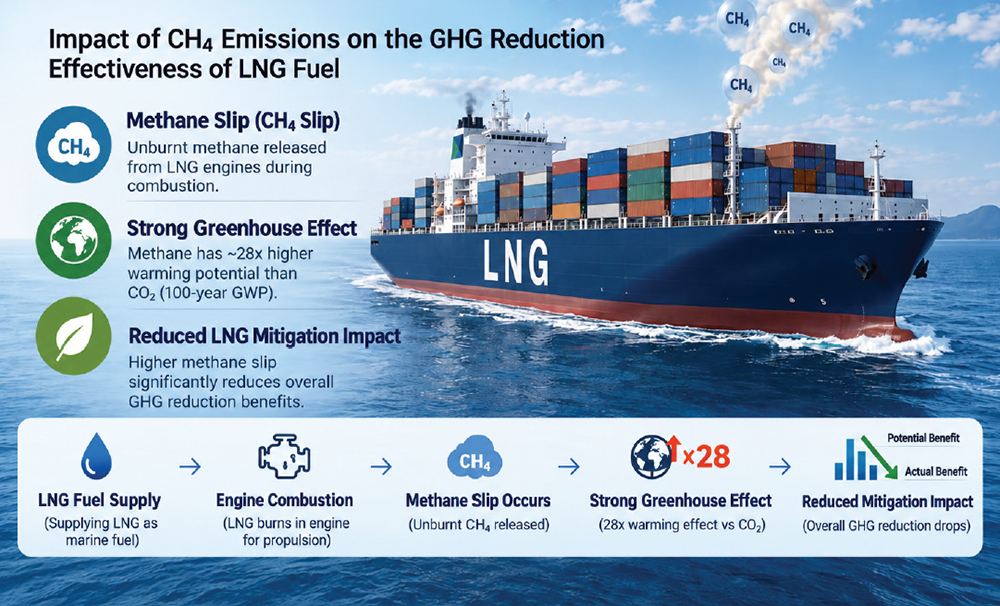
Source: Google Gemini, AI generated image
Methane-slip characteristics are known to vary considerably depending on the type and operating mode of the LNG engine. How do methane-slip characteristics differ between two-stroke and four-stroke engines, and between low-pressure and high-pressure engines? What are the underlying causes?
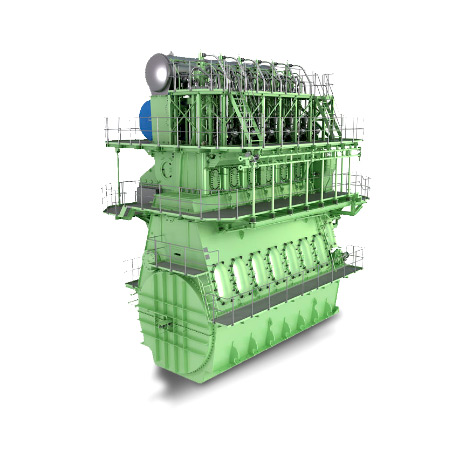
In general, low-pressure Otto-cycle engines have higher methane slip than high-pressure Diesel-cycle engines. Because low-pressure engines supply gas during the intake stroke, unburned fuel may be partially discharged as exhaust gas due to the characteristics of premixed combustion. On the other hand, high-pressure engines directly inject fuel at high pressure after compression, resulting in relatively lower methane slip. In addition, 4-stroke engines have higher methane slip than 2-stroke engines due to combustion chamber geometry and valve overlap. In the case of 2-stroke engines, applying an Exhaust Gas Recirculation (EGR) system resupplies methane contained in the exhaust gas to the intake (scavenge) air, leading to additional methane slip reduction depending on the exhaust gas recirculation rate.
2-stroke engine_Everllence
4-stroke HiMSEN engine H35CDF
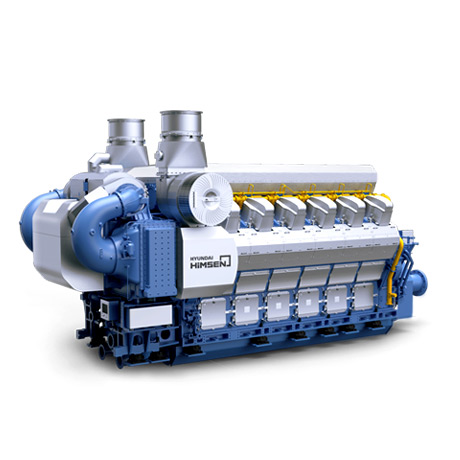
Source: HD Hyundai Heavy Industries website
The EU ETS includes CH₄ and N₂O from the maritime sector within its regulatory scope from 2026, while FuelEU Maritime allows the use of actual measured methane-slip values when certain requirements are met. How do you expect these regulatory changes to affect the competitiveness of LNG-fuelled vessels and engines?
As the EU ETS and FuelEU Maritime begin to fully account for methane emissions, LNG-fueled vessels are also evaluated significantly on CH₄ reduction performance. Consequently, the competitiveness of engine technology with low methane slip is expected to increase further. Conversely, engines with high methane slip levels may incur additional regulatory compliance costs. As a result, GHG emission performance rather than simple fuel cost is likely to become a crucial factor determining engine and vessel competitiveness. In particular, as FuelEU Maritime allows actual measured values (Actual Methane Slip) to be applied upon meeting certain requirements, engine manufacturers' capabilities in methane slip reduction technology and securing actual measurement data will become important competitive factors.
IMO greenhouse-gas regulations require continuous monitoring. In the future, fuel prices and fuel consumption will likely need to be considered together with CO₂ and CH₄ emissions, EU ETS costs, and FuelEU Maritime compliance costs. How do you expect these changes to affect the way shipowners select fuels and propulsion systems?
While fuel prices and fuel consumption rates were primary decision criteria in the past, evaluations from a total GHG cost perspective are expected to become essential. Shipowners will comprehensively consider CO₂, CH₄, and N₂O emissions, EU ETS costs, and FuelEU Maritime compliance costs. Accordingly, investment decision-making taking into account not only the fuel itself but also engine efficiency, methane slip levels, and future fuel conversion potential is projected to expand.
Future Fuel Strategy: Shifting from Fuel Cost to Total GHG Cost
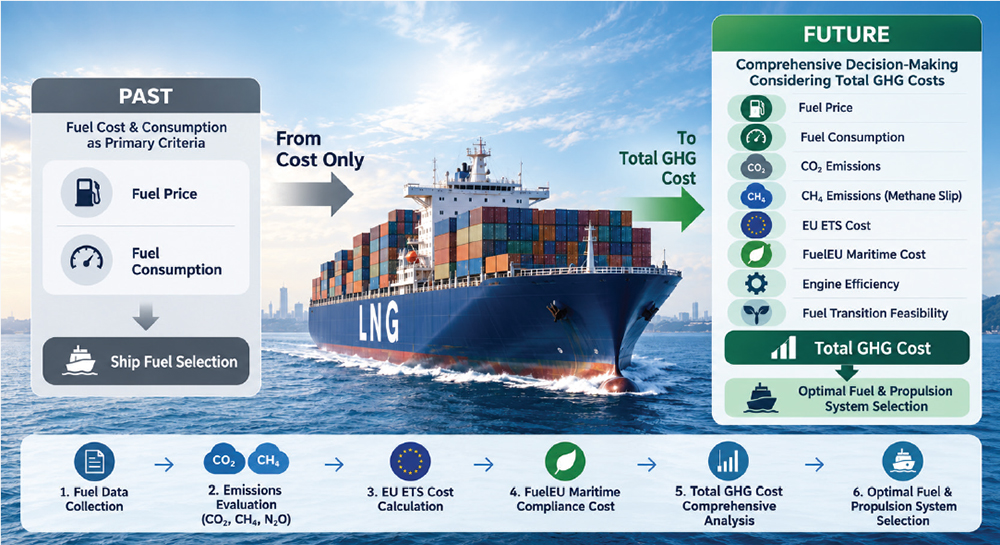
Source: Microsoft Copilot, AI generated image
What technologies are currently being applied within the engine itself to reduce methane slip? What limitations remain when attempting to achieve sufficient methane-slip reduction through in-cylinder technologies, such as combustion improvement, alone?
HiMSEN engines are pursuing methane slip reduction through combustion chamber geometry optimization (crevice volume reduction), improved fuel injection control (MPI: Multi-Pilot Injection / CCO: Cylinder Cut-off), valve timing adjustment, and excess air ratio optimization. These technologies are effective in reducing unburned fuel. However, complete elimination of methane slip under all operating conditions through in-cylinder combustion alone is difficult. Methane generated during low-load operation or in quenching zones near the inner wall of the cylinder liner has technical limits in elimination, making parallel development with exhaust gas aftertreatment technology increasingly important. In connection with aftertreatment systems, MSS (Methane Slip Solution) technology is continuously being developed.
Operating Principles of HiMSEN Engine MSS(Methane Slip Solution) Technology
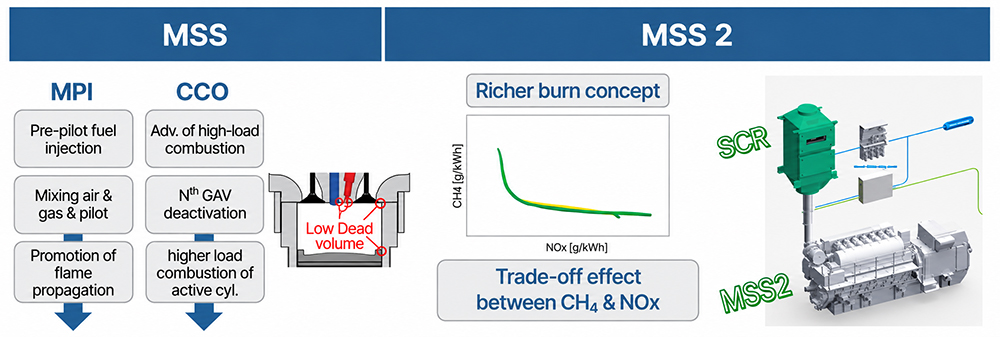
Source: HD Hyundai Heavy Industries
Methane oxidation catalyst (MOC) technology is being studied to address these limitations. What level of methane reduction can be achieved through MOC, and what are the principal technical obstacles currently preventing its commercialization, such as low exhaust-gas temperatures?
The methane reduction performance achievable through Methane Oxidation Catalyst (MOC) varies depending on engine operating conditions such as catalyst specification, exhaust gas flow rate, composition, and temperature, but is generally designed with a target reduction rate of around 70–90%. However, two major technical challenges exist for commercializing MOC technology. First, precious metals used in the catalyst are easily poisoned by sulfur. Therefore, high-performance desulfurization technology capable of effectively removing sulfur in exhaust gas is essential for stable operation. Second, relatively high exhaust gas temperatures are required to activate the methane oxidation reaction. Accordingly, technology to improve low-temperature activity and technology to efficiently heat exhaust gas need to be developed.
To solve these technical challenges, HD Hyundai Heavy Industries' Engine & Machinery Division is developing its proprietary methane reduction solution, MOCS™ (Methane Oxidation Catalyst System). In a recent validation test linked with a 1.5MW-class HiMSEN engine, a methane reduction rate of over 80% was achieved, and superior performance exceeding 90% was confirmed particularly under 75% engine load.
MOCS™ applies S-trap (sulfur adsorbent) technology to prevent sulfur poisoning of the catalyst as well as high-performance MOC, enhancing durability and reliability. Additionally, a Diesel Oxidation Catalyst (DOC) and fuel oil injection system were applied together to effectively raise exhaust gas temperatures.
In particular, an innovative catalyst called SDOC (S-Trap & DOC dual-function catalyst) that integrates S-trap and DOC functions into one was developed. This enables both SDOC and MOC to be mounted inside a single reactor, effectively reducing system size and installation space, thereby further improving shipboard applicability.
Operating Principle of MOCSTM
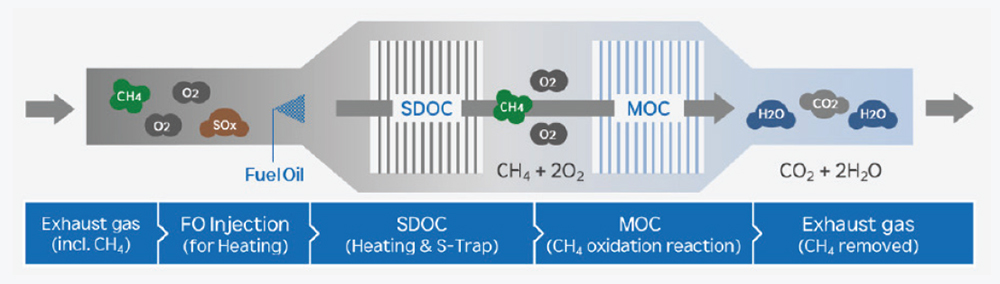
Source: HD Hyundai Heavy Industries
Sulfur in marine fuels and substances originating from lubricating oil can cause catalyst sulfur poisoning and performance degradation. What technical approaches are needed to address catalyst durability and poisoning? Among reduction rate, fuel economy, back pressure, service life, and cost, which do you consider most important for commercialization?
Because MOC uses precious metals as a main component, manufacturing costs are high, and catalyst performance easily degrades due to sulfur. In particular, marine fuels have a significantly higher sulfur content compared to conventional land-based low-sulfur fuels, making catalyst degradation a critical challenge. Therefore, for MOC commercialization, sulfur adsorption technology that minimizes sulfur in fuel or effectively removes sulfur compounds in exhaust gas is essential. Ultimately, the most important factor for successful MOC commercialization is securing long-term durability and service life of the catalyst and sulfur adsorbent, rather than simple reduction performance.
HD Hyundai Heavy Industries' Engine & Machinery Division has already proven technical feasibility by successfully completing land validation tests linked with a 1.5MW-class HiMSEN engine. As the next step, a sea trial performance test will be conducted in 2027 on a vessel equipped with a 2.9MW-class HiMSEN engine. In this sea trial, MOCS will be operated for a long period under actual sailing environments to comprehensively evaluate methane reduction performance, system durability, and operational stability. Based on these demonstration data, HD Hyundai Heavy Industries plans to secure technical reliability and pursue full-scale commercialization of MOCS™ targeting eco-friendly newbuilding and retrofit markets.
Finally, what roles should lower-carbon fuels such as bio-LNG and e-methane, and methane-slip reduction technologies, respectively, play in enabling LNG-fuelled vessels to develop into genuinely low-carbon or carbon-neutral ships?
The future competitiveness of LNG-fueled vessels can only be secured when low-carbon fuels and methane slip reduction technology advance together. Bio-LNG and e-Methane have the advantage of significantly reducing carbon emissions from a Well-to-Wake perspective while utilizing existing LNG infrastructure. Simultaneously, methane slip must be minimized through engine technology improvements and aftertreatment technologies like MOC. Ultimately, when fuel decarbonization and methane slip reduction are achieved together, LNG will be able to fulfill its role as a practical low-carbon or carbon-neutral fuel.