Regulatory Updates
KR Decarbonization Magazine
VOL.14 | OCTOBER 2026
| EU’s Maritime GHG legislation under Revision |
EU MRV to become the common data backbone for the EU ETS and FuelEU Maritime

Executive Summary
On 17 July 2026, the European Commission published proposals to revise the EU ETS Directive (COM(2026) 616) together with the EU MRV and FuelEU Maritime Regulations (COM(2026) 620). The package combines a targeted extension of maritime scope with a broader restructuring of monitoring, reporting and verification, placing EU MRV at the centre of the common data framework used for EU ETS and FuelEU Maritime compliance.
Key proposals at a glance
·Targeted extension of EU MRV and EU ETS to certain ships between 400 and 5,000 gross tonnage (GT)
·A single ship-specific Monitoring Plan and a single MRV Report
·EU MRV expanded to cover energy used and life-cycle (Well-to-Wake, WtW) GHG information
·Verification and accreditation aligned around the MRV framework, while the FuelEU Compliance Balance (CB) Report remains separate
·Stronger safeguards against circumvention and a review mechanism for interaction with future IMO carbon-pricing measures
Context: What is already in force (as of August 2026)
These proposals should be read against a regulatory baseline that is already largely in place.
· EU ETS: CO₂ emissions from cargo and passenger ships of 5,000 GT and above have been covered by the EU ETS since 1 January 2024, and CH₄ and N2O emissions have been covered since 1 January 2026. Surrender obligations were phased in as 40% of 2024 emissions (surrendered in 2025), 70% of 2025 emissions (surrendered in 2026) and 100% from 2026 emissions onwards (surrendered from 2027). Offshore ships of 5,000 GT and above will be brought within the scope of the EU ETS from 2027.
· EU MRV: In addition to ships of 5,000 GT and above, general cargo ships between 400 and 5,000 GT and offshore ships of 400 GT and above have already been within the scope of the EU MRV Regulation since 1 January 2025.
· FuelEU Maritime : Regulation (EU) 2023/1805 has applied in full to commercial ships above 5,000 GT since 1 January 2025. It sets a Well-to-Wake GHG-intensity reduction trajectory against a 2020 baseline of -2% (2025), -6% (2030), -14.5%(2035), -31% (2040), -62% (2045) and -80% (2050).
The European Commission has proposed a further restructuring of the EU’s maritime decarbonisation framework. On 17 July 2026, it published COM(2026) 616, proposing amendments to the EU ETS Directive, together with COM(2026) 620, which would amend the EU MRV and FuelEU Maritime Regulations. The proposals do not merge the EU ETS and FuelEU Maritime into a single regulatory instrument. Instead, their central feature is to establish EU MRV as a common monitoring, reporting and verification framework serving both regimes.
As of August 2026, both files remain legislative proposals under the ordinary legislative procedure. Existing EU ETS, EU MRV and FuelEU Maritime requirements therefore remain applicable unless and until the proposed amendments are formally adopted and enter into force.
Targeted extension to smaller ships
One significant element is the proposed extension of regulatory scope. COM(2026) 620 would bring oil tankers, chemical tankers, gas carriers, LNG carriers, Ro-Pax ships and passenger ships of 400 GT and above but below 5,000 GT into the EU MRV framework from 2029. The expanded MRV system would cover both greenhouse gas emissions and energy used on board.
The proposed EU ETS scope is not identical. According to COM(2026) 616 Annex I, smaller oil tankers, chemical tankers, gas carriers and LNG carriers would remain excluded until 31 December 2030, resulting in their proposed ETS inclusion from emissions occurring in 2031. Smaller Ro-Pax and passenger ships are not automatically included; instead, the Commission would report by the end of 2031 on the feasibility and economic, environmental and social impacts of their possible inclusion.
Proposed Extension of EU MRV and EU ETS to Ships of 400-5,000 GT
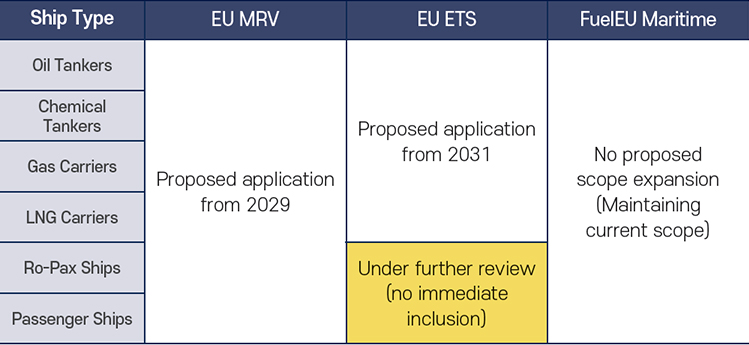
* Note: Based on current legislative proposals and subject to change depending on deliberations by the European Parliament and Council.
Key Timeline for EU Maritime Carbon Regulations
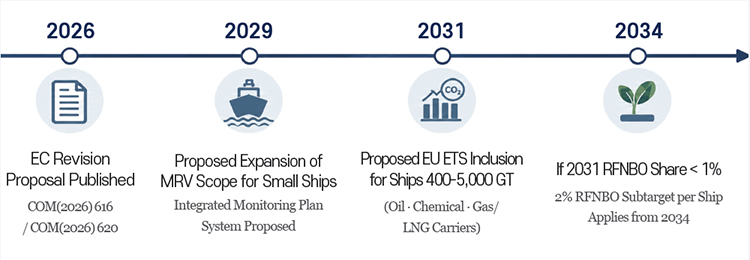
* Note: Based on current legislative proposals and subject to change depending on deliberations by the European Parliament and Council.
Importantly, the proposal does not make the scope of FuelEU Maritime automatically follow the wider MRV scope. Inclusion in EU MRV should therefore not be interpreted as automatic application of FuelEU?셲 substantive GHG-intensity requirements.
A single Monitoring Plan and MRV Report
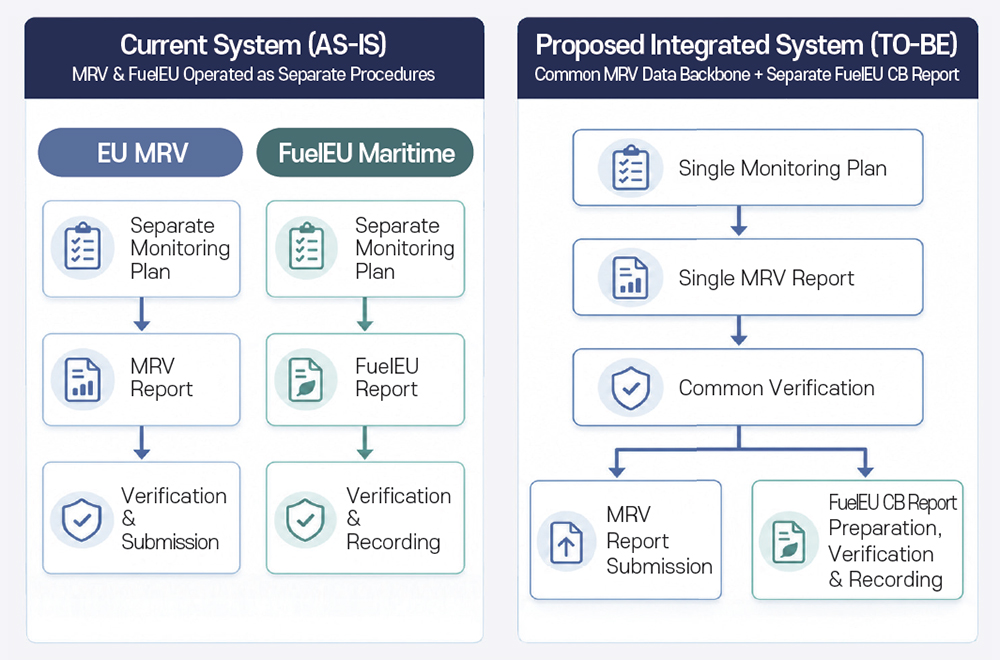
The most signifi cant structural change is the integration of monitoring and reporting procedures. COM(2026) 620 proposes that shipping companies use a single Monitoring Plan and a single MRV Report for each ship, covering both greenhouse gas emissions and energy used on board. The common workfl ow is intended to eliminate duplicate monitoring and reporting of data required for MRV/ETS and FuelEU compliance.
EU MRV would consequently move beyond its traditional focus on fuel consumption and direct emissions. The common dataset would include energy used on board, energy type and quantity, applicable emission factors, Well-to-Tank (WtT) and Tank-to-Wake (TtW) emissions, electricity supplied through on-shore power supply (OPS), and information concerning substitute energy sources and wind-assisted propulsion. The proposal specifi cally requires the WtT and TtW components to be reported separately.
Integration of MRV and FuelEU Maritime compliance processes
For ships already within scope, the proposed text requires an updated Monitoring Plan, assessed by a verifi er as being in conformity with the Regulation, to be submitted to the responsible administering authority by 1 April 2029. The administering authority would approve those plans by 31 December 2029. This distinction is important: the verifi er assesses conformity, while the administering authority grants approval.
FuelEU compliance remains legally distinct
The common MRV framework does not eliminate the underlying diff erences between the EU ETS and FuelEU Maritime. The EU ETS would continue to require shipping companies to surrender EU Allowances (EUAs) for covered emissions, while FuelEU Maritime would continue to regulate the WtW GHG intensity of energy used on board and to impose other substantive requirements, including on-shore power supply (OPS) obligations at berth for containerships and passenger ships.
A separate CB Report would therefore remain under FuelEU Maritime. Based on the verifi ed MRV data, this report would contain the ship’s annual average GHG intensity, compliance balance, non-compliant port calls, annual energy use and, where applicable, RFNBO energy use. Under the proposed workfl ow, companies would provide the CB Report to the verifi er by 28 February, and a compliant report would be recorded by the verifi er in the FuelEU database by 31 March.
The proposal is therefore better understood as an integration of the data and verifi cation architecture, rather than a merger of the substantive ETS and FuelEU compliance obligations.
RFNBO target retained, with reporting and verification linked to EU MRV
FuelEU Maritime includes specifi c measures to promote the use of renewable fuels of non-biological origin (RFNBOs), such as renewable hydrogen, e-methanol and e-ammonia. Under the current Regulation, RFNBO use between 2025 and 2033 benefi ts from a multiplier of two in the GHG-intensity calculation. In addition, if RFNBOs account for less than 1% of the energy used by ships within the scope of FuelEU Maritime in 2031, a 2% ship-specifi c RFNBO sub-target would in principle apply from 2034. That sub-target would nevertheless not apply where monitoring results available before 1 January 2033 show that RFNBOs already account for more than 2% of the energy used by ships within scope, or where the Commission concludes that RFNBO production capacity, geographical distribution or price does not justify its application.
The proposed amendment does not change these target levels. Instead, it would link RFNBO reporting and verifi cation more closely to the EU MRV framework with verifi ed MRV data providing the basis for determining compliance with the FuelEU RFNBO requirement. In other words, the RFNBO objective remains under FuelEU Maritime, while the underlying data and verification process would be integrated into the MRV framework.
Verification and accreditation aligned around the MRV framework
The Commission also proposes greater alignment of verification and accreditation. Under COM(2026) 620, accreditation for FuelEU verification activities would only be issued to verifiers holding valid accreditation for verification activities under Regulation (EU) 2015/757. Verification principles and processes would consequently be anchored more closely in the EU MRV framework. For verifiers that already hold valid EU MRV accreditation, the proposed approach is expected to facilitate the continued provision of both MRV and FuelEU Maritime verification services under a more integrated framework. For example, Korean Register (KR), which is accredited for both EU MRV and FuelEU Maritime verification activities, would be able to continue providing verification services if the proposed framework is adopted.
This is particularly relevant because the verified MRV dataset would no longer cover only fuel consumption and direct emissions. It would also provide the underlying information required to determine lifecycle GHG performance under FuelEU Maritime.
Stronger safeguards against circumvention
COM(2026) 616 also proposes additional measures addressing the risk of ETS circumvention. For containerships, the criteria used to identify neighbouring container transhipment ports would be broadened. The transhipment-share threshold would be reduced from 65% to 50% (applicable to ports within the existing 300 nautical miles distance criterion), while, as a separate new criterion, certain ports located within 150 nautical miles of an EU port and meeting specified infrastructure criteria could also be included. The list would be reviewed annually rather than every two years.
The proposal also contains tailored provisions for ships performing or supporting offshore operations. Offshore worksites would be incorporated into the relevant port-of-call framework, with the aim of ensuring that the use of non-EU offshore bases or intermediate calls does not enable covered offshore activities in EU waters to fall outside the intended ETS framework.
Interaction with future IMO measures
The proposed amendment also addresses the potential interaction between the EU ETS and a global market-based measure adopted by the International Maritime Organization. If such an IMO measure is adopted, the Commission would be required to assess its ambition, environmental integrity and coherence with the EU ETS, including the risk of double payment for the same emissions.
Where appropriate, a subsequent legislative proposal could introduce an IMO deduction mechanism, allowing the number of EUAs to be surrendered to reflect emissions that are also effectively priced under the IMO measure. The current proposal does not itself create an automatic deduction or replace the EU ETS with an IMO system; it establishes a review mechanism to address the interaction between the two frameworks.
A mechanism to support sustainable fuels and zero-emission propulsion technologies
COM(2026) 616 also proposes a dedicated allowance-reservation mechanism to support the deployment of sustainable maritime fuels and zero-emission propulsion technologies — referred to in industry commentary as the "Sustainable Maritime Alternative Propulsion (SMAP)" mechanism. Under proposed Article 3gaa, up to 110 million EU ETS allowances could be reserved through 2040 to support the use of eligible sustainable maritime fuels and the deployment and operation of zero-emission propulsion technologies.
Eligible categories include qualifying advanced biofuels and biogas, RFNBOs, low-carbon hydrogen and low-carbon fuels, as well as electric and wind-assisted propulsion systems. The mechanism is designed to cover part of the remaining price differential between eligible sustainable fuels and conventional fossil fuels, or part of the additional costs associated with eligible propulsion technologies.
The proposed text still contains an alternative formulation for the starting date – "2028" or "the first year after the entry into force of the revised Directive". At this stage the mechanism is therefore best described as one proposed to operate through 2040, rather than as commencing in a specific year.
MRV as the common data backbone
Taken together, the July 2026 proposals point to a clearer division of functions within the EU maritime carbon framework. EU MRV would become a broader common data and verification backbone, covering both greenhouse gas emissions and energy use, including lifecycle-emissions information required by FuelEU Maritime. On top of that common dataset, the EU ETS would continue to impose allowance-surrender obligations, while FuelEU Maritime would retain its separate GHG-intensity and compliance requirements.
In other words, the proposals seek to integrate how data are monitored, reported and verified, rather than to merge the regulatory obligations themselves. Both legislative files remain proposals under the ordinary legislative procedure, while the European Commission is also collecting stakeholder feedback on the proposed amendments through its “Have Your Say” portal. The final scope, application dates and detailed requirements should therefore be confirmed against the legislation ultimately adopted. Developments at the IMO — in particular the ongoing adoption process for the Net-Zero Framework under MARPOL Annex VI — should be monitored in parallel, as their outcome may influence how the interaction with the EU ETS is ultimately handled.